Before the Aesthetic: What the Internet Looked Like When Nobody Was Watching
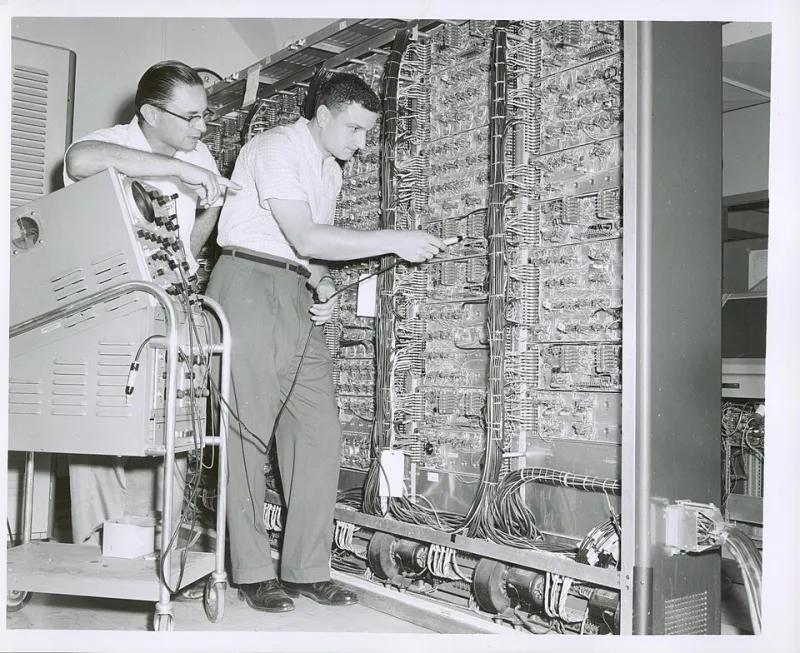
Photo: U.S. Census Bureau employees, Public domain, via Wikimedia Commons
Somewhere around 2012, the internet started cleaning itself up. Not all at once — it was gradual, like a neighborhood going through gentrification. The weird corners didn't disappear immediately. They just got quieter, then rarer, then eventually became the kind of thing you'd reference in a tweet to signal that you were online before it was cool.
What got lost in that cleanup wasn't just content. It was a whole mode of being online — one where experimentation was the default, where nothing was optimized, where the gap between making something and publishing it was basically zero. The pre-algorithm internet was a mess, and that mess was, in retrospect, one of the most creatively fertile environments the culture has ever produced.
The Topology of the Old Web
To understand what's being mourned — and increasingly, deliberately recreated — it helps to map the actual terrain. The early 2000s internet wasn't one thing. It was a loose archipelago of distinct communities, each with its own culture, norms, and internal logic.
SomethingAwful was one of the central nodes. Founded in 1999, it functioned as a kind of creative pressure cooker — a forum culture that was hostile, funny, and genuinely inventive in ways that produced outsized cultural influence. Meme formats, internet vernacular, entire aesthetic sensibilities trace back to SA threads that most people under 30 have never read. The barrier to entry was partly financial (you paid to register) and partly cultural: you had to know how to read the room, which meant spending time in it first.
LiveJournal occupied a completely different register. Where SA was performatively aggressive, LJ was confessional, intimate, and deeply weird in a softer key. Subcultures nested inside subcultures — fanfic communities, goth kids, early queer online spaces, proto-bloggers writing into what felt like genuine darkness. The platform's design encouraged long-form, encouraged vulnerability, and crucially, didn't rank anything. Your post didn't compete with anyone else's post. It just existed, for whoever happened to follow you.
And then there was early Reddit, before the default subreddits swallowed everything — a genuinely strange place where the lack of content moderation produced both the worst and most interesting corners of the platform simultaneously.
What Made It Different
The thing these spaces shared wasn't an aesthetic. It was a structural condition: nobody was watching at scale. There was no For You Page. There was no algorithm promoting content based on engagement signals. There were no brand partnerships, no sponsored posts, no SEO considerations. You made something and posted it because you wanted to, and the audience was whoever happened to already be in the room.
This sounds like a limitation, and in some ways it was. Reach was genuinely constrained. If you made something brilliant on a niche forum in 2003, it might be seen by a few thousand people and then effectively disappear. There was no mechanism for it to travel beyond its original context.
But that constraint had a creative upside that's hard to overstate. When you're not optimizing for reach, you're free to make things that don't travel well — things that are too specific, too weird, too slow, too context-dependent to function as shareable content. The early internet was full of this kind of work. Flash animations that made no sense outside their community context. Forum in-jokes that evolved into entire aesthetic frameworks. Music posted to niche MP3 blogs that existed outside any commercial logic whatsoever.
The Commodification Problem
The shift started slowly, then accelerated. As platforms consolidated and algorithmic feeds replaced chronological ones, the incentive structure changed completely. Weirdness stopped being a natural condition and became a performance — something you deployed strategically to stand out in a crowded feed.
This is the core of what critics of the current internet mean when they talk about aesthetic commodification. Vaporwave is the clearest example: a genuinely strange, community-generated aesthetic that emerged from obscure corners of the internet, got discovered, got written up, got turned into a Spotify playlist category, and in the process lost most of what made it interesting. The aesthetic survived. The weirdness didn't.
The same pattern has played out with cottagecore, with dark academia, with every successive microtrend that gets named and categorized. Naming is the first step toward optimization, and optimization is the thing that kills the actual strangeness.
The Archaeology Project
What's genuinely interesting right now is watching a generation of creators attempt to reverse-engineer the conditions that made the old internet feel the way it did. This isn't nostalgia exactly — it's more like structural archaeology. They're not trying to recreate the content. They're trying to recreate the feeling of making something that isn't watched.
Some of this is happening in the tools. Neocities, a platform that lets people build old-school HTML websites, has seen steady growth as creators deliberately choose the limitations of early web design over the frictionless templates of Squarespace or Wix. The resulting sites look unfinished, personal, and weird in exactly the way that personal websites used to look before everyone started using the same five themes.
Some of it is happening in music communities. Certain corners of Bandcamp and Itch.io function similarly to the old MP3 blog ecosystem — work posted without commercial intent, consumed by small audiences who found it through genuine word-of-mouth rather than algorithmic recommendation. The music itself often reflects the platform's logic: unmastered, unpolished, made quickly and posted without much deliberation.
And some of it is happening in the social spaces themselves. The Discord servers and forums and invite-only newsletters that underground creators are building aren't just distribution infrastructure. They're attempts to recreate the sociological conditions of the old internet — small enough to have actual culture, insular enough to resist the flattening effect of mainstream attention.
What Gets Lost and What Doesn't
It would be dishonest to fully romanticize the pre-algorithm internet. Those spaces were also frequently hostile, exclusionary, and occasionally genuinely harmful. The lack of moderation that enabled weird creative communities also enabled a lot of cruelty. The nostalgia is selective, as nostalgia always is.
But the thing that's worth preserving — the thing that the archaeology project is actually after — is the structural condition of making without watching. The creative freedom that comes from not knowing, or not caring, whether what you're making will travel. The willingness to be specific, unfinished, context-dependent.
The internet didn't get cleaner because people wanted it to. It got cleaner because cleaner content performs better on the platforms that now mediate most of our online experience. That's an economic logic, not a creative one. And the creators doing the most interesting work right now are the ones who've found ways to operate outside it — not by going back, but by building something that functions like what used to exist, on top of the infrastructure we have now.
The signal is still there. It's just quieter than it used to be, and you have to know where to look.