Broken on Purpose: The Artists Who Make Digital Decay Look Incredible
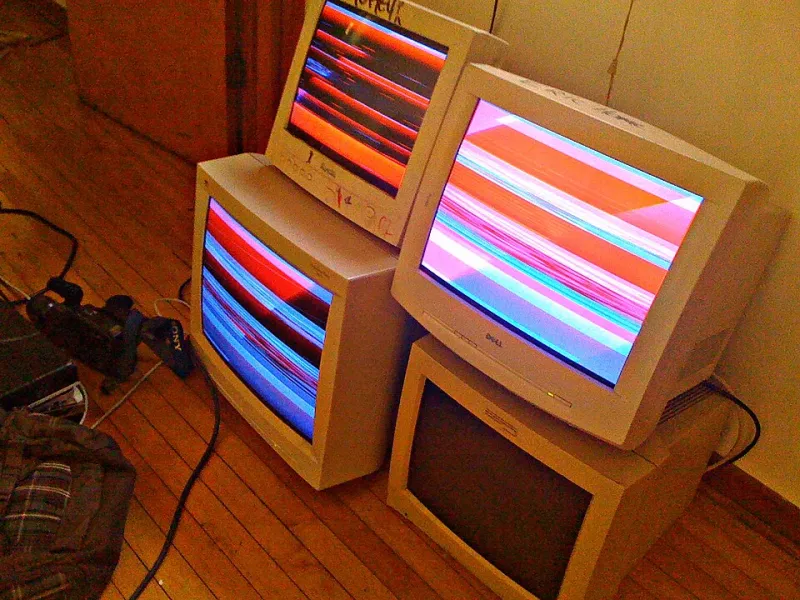
Photo: jonCates, CC BY-SA 4.0, via Wikimedia Commons
Your Computer Is Lying to You (Beautifully)
Open any image file in a text editor, delete a random chunk of its code, and save it. Then open it again as an image. What you get back won't be what you started with — it'll be something stranger, something that looks like the file is trying to remember itself and failing. Blocks of color displaced from their origin. Geometry that shouldn't exist. A face half-dissolved into horizontal static.
For most people, that's a corrupted file. For a specific and increasingly influential community of artists, it's a starting point.
Glitch art — the practice of intentionally introducing errors, artifacts, and degradation into digital media — has been simmering in experimental and avant-garde circles for decades. But something has shifted recently. The aesthetic has escaped its underground origins and is showing up in music videos, gallery installations, short films, and increasingly in the outputs of AI image generators that don't quite do what they're told. The broken look is having a moment, and the reasons why say something interesting about where we are culturally.
The Accident That Became a Method
The history of glitch art is, appropriately, kind of a mess. Its roots run through early video art, through the deliberately degraded aesthetics of industrial and noise music, through the lo-fi visual culture of VHS trading networks and public access television. Artists like Nam June Paik were messing with magnetic fields and cathode ray tubes in the 1960s, finding something expressive in the way electronic signals fall apart under interference.
What the digital era did was make the tools for intentional degradation accessible to anyone with a laptop and a willingness to break things on purpose.
Databending — the technique of manipulating raw file data to produce visual distortions — became a foundational practice. Circuit bending, the physical modification of consumer electronics to produce unintended outputs, crossed over from the audio world into visual art. Artists started building custom software tools designed specifically to introduce controlled chaos into images and video.
The key word there is controlled. What distinguishes glitch art from an actual broken file is intentionality — the artist's ability to recognize which accidents are interesting and reproduce them, to develop a vocabulary of specific failure modes and deploy them with purpose. It's a discipline that looks like disorder.
What AI Got Wrong (And Why That's Fascinating)
If you've spent any time with AI image generators over the past couple of years, you've seen the errors. The hands with seven fingers. The text that resolves into illegible symbol-noise. The face that's almost right until you notice the eye placement. The background architecture that follows no logic a building could actually follow.
For a lot of users, these are frustrations to be engineered around — prompts refined, parameters adjusted, outputs rejected until the model produces something clean and correct.
But a growing number of artists are doing the opposite: deliberately prompting for the errors, studying the failure modes, building aesthetics around the specific ways these systems hallucinate. There's a whole visual language emerging from AI mistakes that looks like nothing else — simultaneously hyper-rendered and fundamentally wrong in ways that feel almost dreamlike.
Artists working in this space talk about it in terms of finding the model's unconscious — the patterns it defaults to when it doesn't quite have enough information to generate something coherent. What comes out in those gaps is weird and specific and, frequently, genuinely compelling.
The philosophical dimension here is hard to ignore. These systems were trained on human creative output, and their errors are in some sense a distorted reflection of that material — familiar shapes and textures and compositional logic, scrambled in ways that reveal the underlying statistical architecture. Looking at an AI glitch image is like looking at a funhouse mirror made of data.
Compression as Aesthetic Choice
Meanwhile, in video and film, a different but related conversation is happening around compression artifacts — the visual noise introduced when digital video is squeezed down to a transmissible size.
Anyone who grew up watching heavily compressed YouTube videos in the mid-2000s knows the look: the blocky macroblocking that appears in fast-motion sequences, the smearing around high-contrast edges, the way faces can momentarily dissolve into abstract color fields during a quick cut. For a long time, these were just the cost of internet video — tolerated imperfections in an otherwise functional medium.
Experimental filmmakers have been reclaiming that aesthetic deliberately, using compression artifacts not as something to minimize but as a texture to compose with. Directors working in music video and short film have built entire visual languages around heavy compression, treating the artifacts as a kind of grain — evidence of transmission, of the distance a signal has traveled.
There's a nostalgia component here that's worth acknowledging. Heavily compressed video carries the visual memory of a specific era of internet culture — a time that feels both very recent and very far away. Using that aesthetic now is, in part, a way of invoking that memory, of locating work in a particular cultural moment.
But the best artists working with compression aren't just being nostalgic. They're using the aesthetic because it does something specific: it makes the viewer aware of the mediation, of the fact that what they're watching is a signal that has been processed and transmitted and that something was inevitably lost along the way.
The Gallery Is Paying Attention
For a long time, glitch art existed almost entirely outside institutional art contexts — it lived online, in zines, in experimental music and video scenes that operated well outside the gallery world. That's been changing.
Major art institutions have started engaging seriously with digital and new media art in ways they weren't a decade ago, and glitch aesthetics have come along with that shift. Artists like Rosa Menkman, whose theoretical writing on glitch has been as influential as her visual work, have built substantial critical reputations. The Whitney, MoMA, and various international biennials have all featured work that engages seriously with digital failure and degradation.
What's interesting is how this institutional recognition has affected the practice itself. For some artists, the gallery context changes the work — it gets bigger, more formal, more explicitly conceptual. For others, the whole point is maintaining the scrappy, distributed, screen-based nature of the medium. A glitch piece that lives on a website and can be viewed on any device is doing something different than one installed on a monitor in a climate-controlled room.
Why Broken Resonates Right Now
There's a reason this aesthetic is landing the way it is in 2024. We live inside systems — algorithmic, social, political — that present themselves as seamless and inevitable, that hide their own machinery and present smooth surfaces to interact with.
Glitch art makes the machinery visible. It insists on the constructed, contingent, fallible nature of the digital environments we inhabit. When an image breaks apart into its component data, it's a reminder that the image was always data — that the seamless surface was always a kind of agreement, and that agreements can fail.
That's not just an aesthetic statement. It's an epistemological one. And in a moment when questions about what's real, what's generated, and what's been manipulated are genuinely urgent, art that foregrounds those questions — that makes visible the gap between the signal and what we receive — feels like it's doing necessary work.
Beautiful, strange, necessary work.