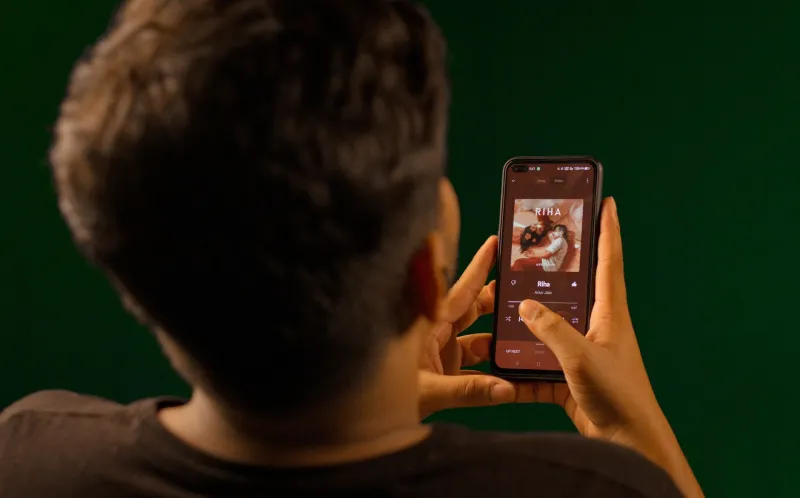
The Counter Reads Zero. The Room Has Never Been Fuller.
Photo: Acabashi, CC BY-SA 4.0, via Wikimedia Commons
I want to make an argument that sounds insane on its face: some of the most important performances happening right now are the ones nobody can prove happened.
Not unannounced shows. Not secret shows. Shows where the counter is off. Streams where the number in the corner has been disabled, hidden behind a toggle, or never turned on in the first place. Listening sessions posted to a private link with no attendee list. Tiny digital performances staged at a volume and scale that all but guarantee an audience you could fit in a Honda Civic.
If you've spent any time in the parts of the internet where the underground still lives, you've seen this. You may have already been part of it without registering that it was a choice.
Zero Is a Number Too
The conventional wisdom is that a creator wants reach. More eyes, more plays, more of the thing that gets called growth. Every tool built in the last decade is designed around that premise — the live counter, the concurrent viewer number, the little graph that spikes and then decays and leaves you staring at the decay.
So when someone turns the counter off, it reads as a mistake. Or a flex. Or a bit.
It's rarely any of those. Ask the people doing it and the answers cluster around a single idea: the number changes the performance. Not the performance in some abstract artistic sense — the actual thing happening in the room. When there's a counter, everyone in the chat can see how many people are there, and everyone adjusts. The artist plays to the number. The audience performs for the number. A quiet song gets a little louder because you can feel the room draining. A weird song gets cut because the graph dipped. The whole thing bends toward retention.
Turn the counter off and the bending stops. There's no dip to watch. There's no spike to chase. There's just a room.
The Room Without a Scoreboard
Here's what's strange about a room without a scoreboard: it feels bigger. Not in size — in attention. When you can't see how many people are there, you can't sort them into tiers. You can't decide the night is a disappointment at 14 viewers or a triumph at 1,400. You have to evaluate it the old way, which is by whether it was any good.
That's a genuinely different cognitive setup, and anyone who has played a sparsely attended show in a real physical room will recognize it. The basement show with nine people in it that turns into the best set of the year. The bar gig where four people are paying attention and one of them cries. There was no counter on the wall. There was no way to know, in the moment, whether the night counted. So you just played.
Streaming flattened that out, then made it worse by adding a public scoreboard to the wall of every basement in America. Turning the counter off is, functionally, taking the scoreboard down. It's an attempt to get back to the thing that made the small room feel like a small room and not a failed stadium.
The Case Against the Counter
I'm not going to pretend there's no downside. Hiding the number hides the bad nights too. Artists who can't see the count lose a diagnostic tool, and the ones who are struggling get one fewer piece of evidence that maybe they should change something. There's a version of this where the counter-off stream becomes a way of avoiding useful feedback, and I've watched that happen.
But the counter was never really feedback. It was a proxy for feedback that got treated as the thing itself. One thousand viewers tells you nothing about whether the set landed. It tells you someone's thumbnail worked. Meanwhile the actual useful information — did the room stay, did people say something real afterward, did the one guy in the back who never comments type four words that reframe your whole approach — arrives almost entirely outside the number.
And there's the uglier side. Public concurrent numbers create a permanent status hierarchy inside a scene. Everyone can see who pulled 800 and who pulled 60, and that ranking calcifies into who gets asked to play the bill, who gets the write-up, who gets treated as a real artist. Small scenes survive on generosity. A visible scoreboard makes generosity feel like charity.
What Intimacy Costs When Nobody's Counting
The zero-view performance is, I think, the most honest form of the thing. Not because suffering is noble, and not because obscurity is a virtue. But because a performance made for an unmeasured room can only be judged by the people in it, and that forces a kind of presence you don't get anywhere else.
It also produces a specific species of loyalty. People who were there for the counter-off stream talk about it like a secret they've agreed to keep. The lack of a number means the lack has to be made up for socially — people remember. They tell each other. The event survives through word of mouth, which is the only distribution channel that has never been successfully automated.
There's a word for this and the word is not scarcity marketing, though it gets mistaken for that constantly. Scarcity marketing hides the thing so you'll pay for it. This is closer to the opposite. The thing isn't hidden. It's just not counted. The door is open. Nobody's at the door with a clicker.
For Nobody, On Purpose
I'll say the obvious thing: I don't think the counter comes back. The infrastructure keeps making the number louder, and the artists who've felt what it does to a room keep finding quieter ways to work. The two paths are diverging and it's fine. The metrics economy needs its numbers. The rest of us don't.
So the next time you get a link from someone with no context and no attendee count and a start time that's already passed, click it. It'll be four people and a person with a laptop and something they wanted to try. It will be the best room you're in all month.