Dial Tone Underground: The Artists Turning Burner Numbers Into Back Rooms
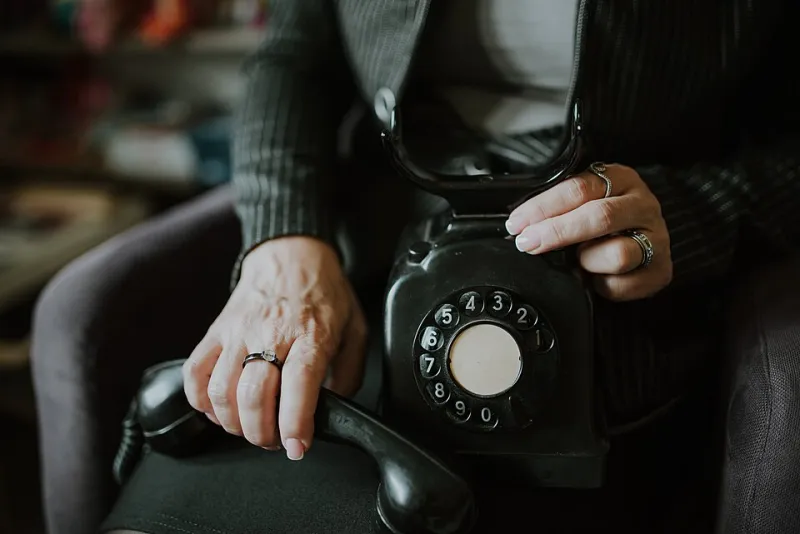
Photo: Shixart1985, CC BY 2.0, via Wikimedia Commons
There is a particular kind of silence that happens after you dial a number you were not supposed to have. Not dead air. Not a busy signal. Just a pause, then a click, then a voice that sounds like it was recorded in a closet in Brooklyn at 2 in the morning. Maybe it's a guitar line. Maybe it's a location. Maybe it's someone saying, don't post this.
Welcome to the phone line as venue. Across the US, experimental musicians and visual artists are using burner numbers, voicemail drops, and automated hotlines to move unreleased tracks, show addresses, and one-off messages without ever touching a feed. The number gets passed around like a password. The art happens in your ear. And when it's over, there is nothing to screenshot.
A Number Is Not a Link
The appeal is not nostalgia. Nobody is arguing that rotary phones were better. The appeal is that a phone number is a bad hyperlink. It doesn't index well. It doesn't autoplay. It doesn't come with a comment section. You can't share it without giving something up—your anonymity, your attention, or your willingness to look a little weird typing seven digits into a keypad.
In Oakland, a noise artist who goes by the name Soft Relay has been running a hotline since early 2026. Callers hear a menu: press one for a new track, press two for a reading from a torn notebook, press three to leave a message that might end up in the next release. There is no website. There is no mailing list. The only way to find it is to know someone who knows someone.
'It's not about being mysterious,' Soft Relay said. 'It's about making the listener do one small, inconvenient thing. That inconvenience is a filter. It means you actually wanted to be here.'
The Voice Is the Ticket
Voice-only channels feel intimate for reasons that are hard to fake. A text can be forwarded. A screenshot can be reposted. A voice memo can be recorded, sure, but it still carries breath, hesitation, room tone. You can hear someone shifting in a chair. You can hear a car pass. The medium refuses polish in a way that makes the message feel less like content and more like a call.
That intimacy is also why phone lines are becoming a distribution strategy for artists who are tired of the algorithm's flattening effect. A track that drops on a streaming platform arrives with artwork, metadata, and a recommendation engine attached. A track that arrives through a voicemail arrives naked. It is harder to compare, harder to rank, harder to turn into a number.
Fans have noticed. In group chats from Chicago to Tacoma, people trade numbers the way they used to trade burned CDs. Some numbers are one-time use. Some are permanent. Some are decoys that lead to a recording of someone laughing. The uncertainty is part of the point.
Why Nobody Wants a Transcript
There is an obvious question: why not just post the audio? The answer is that posting is a promise of permanence. A feed says, this is here, come back later, bring your friends, leave a like. A phone line says, this is happening now, and then it might not happen again.
That impermanence is increasingly valuable in 2026. The internet is full of archives. Every story has a timeline. Every artist has a paper trail. The phone line offers a rare thing: a channel that resists the scrape. It can be documented, but only poorly. It can be shared, but only awkwardly. It can be found, but not easily searched.
For artists, that is a form of control. For fans, it is a form of participation. You are not consuming a drop. You are receiving a call.
The Scene That Can't Be Googled
None of this means the phone line is replacing the feed. It is a side channel, a service entrance, a back room with a landline. But it is also a signal. In a moment when every platform is optimizing for discovery, a number that only spreads by word of mouth is a way of saying: this is for us, not for everyone.
The encore is not a voicemail, exactly. It is a choice. The choice to make art that arrives at the speed of a conversation, not a refresh. The choice to let some things stay unsearchable. The choice to make the listener pick up the phone.